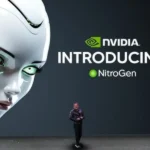

Nvidia unveiled NitroGen, a groundbreaking open vision-action foundation model trained on 40,000 hours of gameplay from over 1,000 games. This AI acts as a generalist gaming agent without needing reinforcement learning, learning directly from raw pixels and gamepad actions. The release signals a major leap in efficient AI training for gaming and beyond.
What Makes NitroGen Revolutionary
NitroGen excels by skipping traditional RL pipelines, instead using vast raw gameplay data for emergent skills like navigation and object interaction. It demonstrates strong zero-shot transfer to unseen games and even real-world robotics tasks, outperforming prior models on benchmarks. Trained on diverse genres from action to strategy, the model handles complex environments with minimal fine-tuning.
Technical Breakdown
- Training Scale: 40,000 hours across 1,000+ games, focusing on vision-action pairs for broad generalization.
- Key Innovation: Direct policy learning from pixels—no reward engineering or simulators required, cutting compute needs dramatically.
- Performance: Tops leaderboards in ProcGen and Atari suites, with emergent behaviors like tool use in novel settings.
Open-sourced by Nvidia, NitroGen invites researchers to build on its foundation, accelerating agentic AI progress.
Real-World Implications
Beyond gaming, NitroGen paves the way for robotics, where pixel-based control mirrors real sensor data for tasks like manipulation. It challenges the RL dominance in embodied AI, potentially speeding adoption in simulations, autonomous systems, and virtual training. As AI divides grow between resource-rich firms, open models like this democratize access.